 Sun City Center Golf Cart Repair
 Golf Cart Battery Replacement in Sun City Center
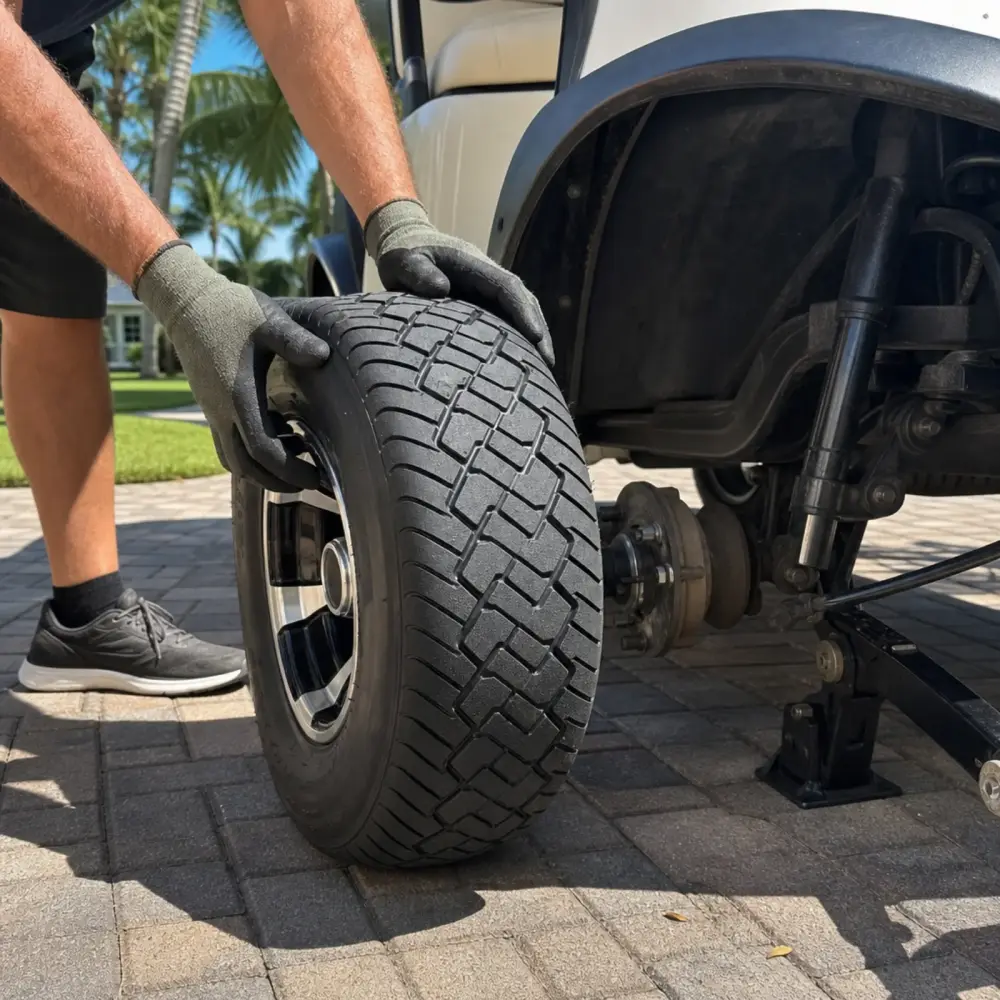
Sun City Center Golf Cart Repair installs complete battery packs at your home: lead-acid packs $1,200–$1,800 installed for most carts (36V packs from about $1,200, 48V packs up to roughly $1,800 with premium brands) including terminal service, a full watering, and haul-away of the old cores. Lithium conversions run $1,600–$3,500 installed. Batteries are usually on the truck, so most replacements finish in a single driveway visit.
The battery pack is the biggest predictable expense of cart ownership, and in Sun City Center it comes due sooner than owners expect. Here’s the honest version of why, and of every decision that matters.
Why packs age fast in this community
Battery life is measured in discharge cycles, not years, and a Sun City Center cart racks up cycles like nowhere else in Tampa Bay. This is a community where the cart replaced the second car: the daily loop to the plazas along SR 674, the run across a designated crossing to a doctor’s office, club meetings, golf, the US 301 crossing to Walmart. Every outing is a partial cycle, and there’s no winter storage season to slow the count. A cart that would cycle twice a week on a golf course cycles daily here, year-round.
Florida heat compounds it. Hot electrolyte in a flooded battery evaporates fast; when the level drops below the tops of the plates, the exposed lead sulfates and that capacity never comes back. A pack that goes unwatered through one Tampa Bay summer can age two years in four months. Snowbird carts get the other failure mode: months of self-discharge in a hot garage, then an October surprise. Both show up on our load tester constantly, and both are cheaper to prevent with a tune-up than to cure with a pack.
Symptoms, in the order owners notice them
- Shrinking range, the loop that used to use half a charge now runs the meter low.
- Longer charge times. The charger runs hours past its old finish, or never quite clicks off.
- Voltage sag under load, the cart slows noticeably pulling away from stops or on the long straight home.
- The hard failure, one battery quits, and a series pack is only as strong as its weakest cell.
One caution before you spend anything: these symptoms overlap almost perfectly with charger faults. A charger putting out low current starves a healthy pack and imitates battery death. We test charger output and load-test each battery individually before quoting, if the real fix is a $300 charger instead of a $1,200 pack, that’s the quote you’ll get. And when the load test shows one dead battery in a young pack, replacing just that battery is legitimate; in an old pack it isn’t, because fresh cells wired in series with tired ones get pulled down to the pack’s level within months. We’ll tell you which case you’re in.
Lead-acid vs AGM vs lithium: the actual choices
| Flooded lead-acid | AGM | Lithium (LiFePO4) | |
|---|---|---|---|
| Installed cost | $1,200–$1,800 | Above flooded, below lithium | $1,600–$3,500 |
| Typical life | 4–6 years | Similar, less abuse-tolerant of deep cycling | 7–10+ years |
| Watering | Monthly in Florida heat | None (sealed) | None |
| Charging | Overnight | Overnight | A few hours |
| Weight | ~350+ lbs | Similar | Roughly a third |
| Power delivery | Sags as it discharges | Sags less | Steady until nearly empty |
Flooded lead-acid is the default and the value play, Trojan T-105s (6V) and T-875s (8V) are the benchmark cells for a reason, but it demands the watering schedule. AGM suits owners who want sealed, maintenance-free batteries without the lithium price, at some cost in deep-cycle longevity. LiFePO4 lithium wins for true daily drivers over a ten-year window: one purchase instead of two, zero maintenance, faster turnaround between errand runs, and no sag. For a lightly used or seasonal cart, lithium buys cycle life you’ll never use, lead-acid wins that math, and we’ll say so.
Batteries you bought yourself: what to sort out before the install
Owner-supplied sets are fine to install, and a labor-only visit is a normal request. Three things decide whether it goes smoothly.
Every battery in the string has to match. A cart pack is wired in series, so the weakest unit sets the pace for all of them. Same type, same capacity, same age, ideally the same shipment. Trojan does not recommend partially replacing a flooded bank because mixed old and new batteries charge unevenly, and mixing types is worse: one flooded battery dropped into an AGM set (or the reverse) means two chemistries sharing one charger that can only suit one of them.
The charger has to suit AGM. Trojan’s maintenance guide limits equalizing to flooded batteries only, and a charger built for a flooded pack may not be set up for sealed ones. Check the charger’s label or manual for an AGM or sealed setting, or confirm with its maker, before the first charge.
Wait for the full count. Six 6-volt batteries make a 36-volt pack and six 8-volt batteries make a 48-volt pack; five of either leaves the cart short of its rated voltage, and it should not be driven that way. If the shipment came up one short, book the install once the last battery arrives, and check that it carries the same model and a close date code to the other five.
What the install includes
Every replacement gets the same finish: cables inspected and replaced if corroded, terminals cleaned and coated against humidity, hold-downs torqued, a full watering on flooded packs, a test drive, and old cores hauled away for recycling. Lithium conversions include the correct lithium-specific charger. A lead-acid charger’s profile will not properly charge LiFePO4. Afterward, the maintenance that decides pack life is simple: keep flooded cells watered with distilled water (after charging, never before), keep terminals clean, and charge after use rather than storing the cart discharged. A hydrometer reading of specific gravity across cells is the cheapest early warning there is, and it’s part of every annual service.
Get a battery quote
Tell us the cart brand and a battery count (six 6-volts is a 36V pack, six 8-volts or four 12-volts is 48V) plus a photo of the compartment. You’ll get a flat installed price against our published ranges, usually with same-day or next-day installation across Sun City Center, Kings Point, Ruskin, Apollo Beach, Wimauma, and Riverview.
Frequently Asked Questions
What does a full battery pack cost installed?
Lead-acid packs run $1,200–$1,800 installed for most carts: 36V six-battery packs from about $1,200–$1,600, 48V packs up to about $1,800 with premium brands like Trojan. That includes installation, cable and terminal service, a full watering, and haul-away of the old cores.
How do I know my pack is actually dead?
Shrinking range, a charger that runs far longer than it used to, and sag on the way home are the classic signs. We confirm with an individual load test on each battery, sometimes one or two bad batteries are dragging down the rest, and on a young pack that changes the repair.
How long will a new pack last in Sun City Center?
Roughly 4–6 years for lead-acid, and daily-driver carts here trend to the short end because they cycle year-round and Florida heat evaporates electrolyte. Monthly watering and clean terminals buy you the long end. Lithium runs 7–10+ years.
Is a lithium conversion worth it?
For a true daily driver, often yes: 7–10+ year life, no watering, faster charging, steady power, at $1,600–$3,500 installed. For a lightly used or seasonal cart, quality lead-acid usually wins the math. We run your actual usage, not a pitch.
What happens to the old batteries?
They leave with us, included in the price. Lead-acid cores have recycling value, so there's no disposal fee and nothing heavy left sitting in your cart garage.
I already bought the batteries. Can you just install them?
Ask for a labor-only quote and say so when you request it. Before anyone comes out, check three things: the new batteries match the cart's voltage and count (six 6-volts, six 8-volts or four 12-volts, never mixed with old cells), the cables and hold-downs fit the new case size, and the charger matches the chemistry, because a lead-acid charger will not properly charge a lithium pack. The battery warranty stays with the seller, so keep the receipt. Old cores still need recycling, so ask whether haul-away is included on a labor-only job.